Showing posts with label economy. Show all posts

Thursday, December 13, 2012

And We're Falling Off Which Cliff?


So what about that Fiscal Cliff?

If your anything like the millions of Americans who listen to public radio or can’t seem to tear themselves away from the television, you’ve probably heard the phrase “fiscal cliff” more than a few times, sometimes praised and frequently condemned. But what exactly is the fiscal cliff?

Projected budget analysis graph. Alternate scenario is
with extension of tax cuts and without program cuts.
                The phrase comes from the shape of the graph which shows the government’s net revenue vs. time. The current prediction, with the end of the Bush tax cuts, a planned increase in tax rates, and the beginning of the program reductions detailed in the Budget Control Act of 2011. These reductions are intended to be widely applied but not to cut too deep, with shallow cuts to nearly every department (a few are immune; veterans affairs, medicare, etc.)

                There is much discussion involving whether or not reaching the fiscal cliff is in fact the safest route for the country. This debate stems from the division on economic theory found in Congress, commonly understood through something called Keynesian theory. John Keynes was an economist who in 1936 published The General Theory of Employment, Interest, and Money. Keynesians argue that in times of recession the government should increase spending, taking a deficit in order to stimulate the economy. More projects, more employment, and more benefits will then push the economy more quickly into surplus.

                Non-Keynesian economists argue that recessions are a time for the government to decrease spending. In a more common sense argument, they argue that the government is the structural backbone of the economy, and in lean times should tighten its belt to control the damage of the recession.

                The true right answer to this question is probably a combination of the two. However, which one will be applied in the coming months and years to America’s economy remains to be seen. Democrats, who favor Keynesianism, currently control both the Senate and the White House, while the non-Keynesian Republicans control the House.

WE

Thursday, April 26, 2012

The Syria Conflict: What it means for Your Table

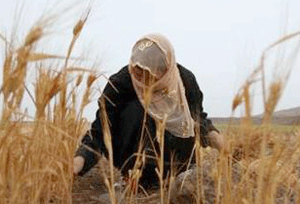
Syria. The name in most people’s minds brings up exotic images of a barren wasteland, covered in desert and strange rock formations a la George Lucas’ Tatooine. The truth however, is far different. The country is far from barren, producing enough food to not only be generally self-sustaining, but to be a significant exporter of a variety of different foods, among them cotton, wheat, and beets.

                So what does that mean for us, the common American? The answer is: maybe a lot, maybe not much. The key to this is seeing how everything is connected. So how is Syria connected to your dinner table?
            
    It starts, of course, with the dollar. One of the ways that the value of the dollar is decided is by how many different countries use the dollar for a trade standard, and thereby to measure debt.
                Syria currently has a fairly massive federal debt, primarily to countries in the EU. Let’s take Poland for example, a country to which Syria owes an amount roughly to a quarter of Syria’s GDP. These countries are currently trading using the dollar.


                The conflict in Syria means a lot for the Syrian government’s ability to pay its debts on time. This is particularly bad timing for this to happen, for one clear reason: Europe is in trouble. The federation is looking at climbing debt and rising unemployment, with Greece leading the pack in trouble, but with many other countries, Poland included, not far behind.


                With one more country falling behind, this is another added burden on a European and thereby world economy that isn’t ready to handle it. And while we may not live in Europe, we cannot untangle our economy from the worlds. The less the Syrian people are putting on the table of Polish families, the more likely it becomes that we will have difficulty putting food on our own tables.

WE